

Clean Energy Beneath Our Feet launches at Glasgow Science Centre
A new interactive exhibition has launched at Glasgow Science Centre, inspired by the work of the UK Geoenergy Observatories.
13/03/2022 By BGS Press

The team has launched a new exhibition at Glasgow Science Centre.
The is one of two new facilities that will help shed light on how underground heat resources could warm our homes and businesses.
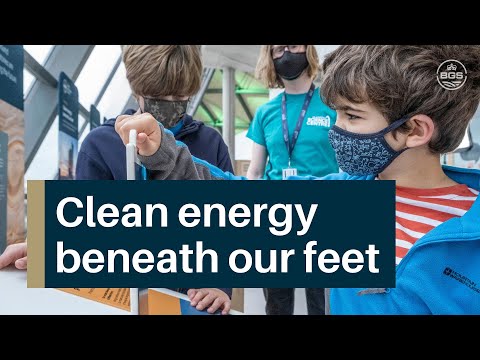

Visitors can learn about how resources below the ground have powered our homes, towns and industries in the past, and what鈥檚 coming up in the future.
The exhibition is called Clean Energy Beneath Our Feet and is on display now in Glasgow Science Centre鈥檚 Powering the Future zone.
Visitors can learn about how resources below the ground have powered our homes, towns and industries in the past, and what鈥檚 coming up in the future.
The exhibition was created by Glasgow Science Centre for the UK Geoenergy Observatories project.

The interactive exhibition has launched at and will聽 tour science centres, museums and festivals throughout the UK. BGS 漏 UKRI.

The exhibition includes core samples taken from the geoenergy observatory in Glasgow. BGS 漏 UKRI.

The exhibition has been designed to appeal to all audiences with an interest in earth and environmental science. BGS 漏 UKRI.

Interactive elements include a holographic presentation illustrating how old coal mines can provide low-carbon heating. BGS 漏 UKRI.
The has 12 boreholes that are collecting data and acting as laboratories so that we can understand whether the warm water in abandoned mines could be used to power Glasgow or other cities. It was commissioned by UK Research and Innovation鈥檚 (UKRI) Natural Environment Research Council (NERC) and was delivered by BGS, which runs the site and manages its data. A second observatory is proposed in .

If we鈥檙e going to reach our net zero goals by 2050, we need a huge supply of clean energy.
This interactive exhibition examines just that and shows the major role that the subsurface will come to play in our future.
Visitors can interact with the science and technology that will shape energy in the future, touch a rock sample we took from 137 m below the surface of Glasgow and learn about the world-class science that鈥檚 taking place at the Glasgow geoenergy observatory in the east end.
Alison Robinson, NERC Deputy Executive Chair.聽
The new exhibition will be of interest to anyone keen to find out more about the use of geoenergy.
We designed it with the UK Geoenergy Observatories team so that it can travel to other science centres, museums and festivals in the UK, but for now it鈥檚 on show at Glasgow Science Centre.
Robin Hoyle, director of science at Glasgow Science Centre.
The Glasgow Observatory is part of a 拢31 million investment by the UK government through the Department for Business, Energy & Industrial Strategy (BEIS).
Find out more about the Glasgow Observatory by taking a .
Related news

UK Critical Minerals Intelligence Centre makes recommendations for the next UK criticality assessment
01/07/2026
CMIC has outlined the enhancements made to the next assessment update to ensure it is better tailored to the structure of the UK economy.

From archive to discovery: historical mineral reports support gold exploration in Scotland
25/06/2026
Digitised geological records show potential to unlock untapped mineral resources in Ardlochan, Argyllshire.

UK and Philippines scientists investigate natural hydrogen generation processes at atomic scale
22/06/2026
BGS researchers were granted access to use the Diamond Light Source facility in order to study hydrogen in light brighter than the sun.

Shortage of end-of-life materials presents challenge to UK critical minerals security
17/06/2026
A new report by the UK Critical Minerals Intelligence Centre reveals insufficient end-of-life material stocks present a supply risk over the coming decade, but offer significant long-term potential to meet critical mineral demand through recycling.

UK geothermal catalogue receives update
16/06/2026
BGS releases the second digital version of the UK geothermal catalogue of subsurface temperature and rock thermal conductivity measurements and heat flow calculations.

Scientists make new discovery in the history of the Giant鈥檚 Causeway
15/06/2026
New research is changing our scientific understanding of the formation of one of the UK鈥檚 most iconic landmarks and has revealed that Northern Ireland鈥檚 volcanic past occurred over a much shorter period than previously thought.

Latest research emphasises climate-related subsidence risk to millions of British homes
11/06/2026
New data from BGS highlights the projected future impact of warmer, drier summers and underlines the need for mitigation measures in susceptible regions.

Ukraine and the UK strengthen their commitment to geological cooperation
10/06/2026
A new Memorandum of Understanding reaffirms the UK鈥檚 support of Ukraine鈥檚 ambitions to develop its critical mineral resources, paving the way for collaboration through capacity-building programmes.

Newly released core could hold clues on potential mineral prospectivity in Perthshire
05/06/2026
A comprehensive collection of geological samples from the vicinity of a former mine in Scotland is now available to scientists for further research.

Latest data on world mineral production now available
25/05/2026
BGS has released the updated statistics on the global production of over 70 commodities between 2020 and 2024.

International science consortium to聽survey聽the health, economic聽value聽and social importance聽of Lake Victoria聽
22/05/2026
The project will replicate the 1927 survey to assess changes in the lake鈥檚 health, economic value and social importance.

New geological maps of Berwick-upon-Tweed to help future-proof natural water supply
20/05/2026
Scientists have mapped the geology under the town to better understand the groundwater system to inform decisions around abstraction.